Best Knowledge Base Tools for Intercom (Fin) Users in 2026
Because Fin is only as good as what it reads.

Updated August 2026
If you are on Intercom (now Fin), your knowledge base depends on what is actually breaking. Intercom's native Articles and Knowledge Hub stay closest to Fin, while tools like Pageloop, Freshdesk, Help Scout, Guru, and Document360 add the maintenance, structure, or governance that Intercom's built-in knowledge base leaves thin. This post covers what Intercom Articles does well, where it falls short for AI-powered support, and what tools Intercom users add or switch to when they need more from their help center.
There is also a bit of extra reason to look around right now: in June 2026, Salesforce agreed to acquire Fin, formerly Intercom, for about $3.6 billion. Nothing changes overnight, but pricing and roadmaps tend to move after a deal that size, so it is a fair moment to know your options.
Why your Intercom (Fin) knowledge base matters more now
Intercom's AI agent pulls directly from your help center articles to generate responses. Every hole in your knowledge base, an outdated article or a vaguely structured section, shows up as a question Fin cannot answer accurately. Intercom is upfront about this: before enabling Fin, its own support team reviewed and updated more than 700 articles so that everything Fin would read was current. On well-maintained content, Intercom reports Fin resolves around 76% of support questions.
Most teams do not have the bandwidth for a one-time audit of that scale, let alone an ongoing process to keep articles in sync with every product release. When your product ships weekly and your knowledge base updates quarterly, Fin is always answering from something a few versions behind.
The tools below address different parts of that problem. Some replace Intercom Articles entirely, some sit alongside it. The right choice depends on what is breaking in your current setup.
What to look for if you are already on Intercom
Before evaluating any tool, get specific about the problem you are solving. If Fin is giving wrong answers, the issue is likely stale or inaccurate articles, and you need something that surfaces outdated content proactively rather than when a customer trips over it.
If Fin cannot answer certain questions, that points to content gaps, so you want a tool that identifies what is missing from real customer queries. If your help center is simply hard to maintain at scale, the issue is tooling, and it helps to know where Intercom Articles hits its limits:
Exporting your full knowledge base means going through the REST API, with no one-click export in the UI.
The Help Center shell stays public. Intercom's "private" controls apply to individual articles, not the whole site.
The collection hierarchy tops out at three levels.
There is no built-in version control, article staging, or reviewer role for teams that need an approval trail.
The 5 best knowledge base options for Intercom users in 2026
1. Pageloop
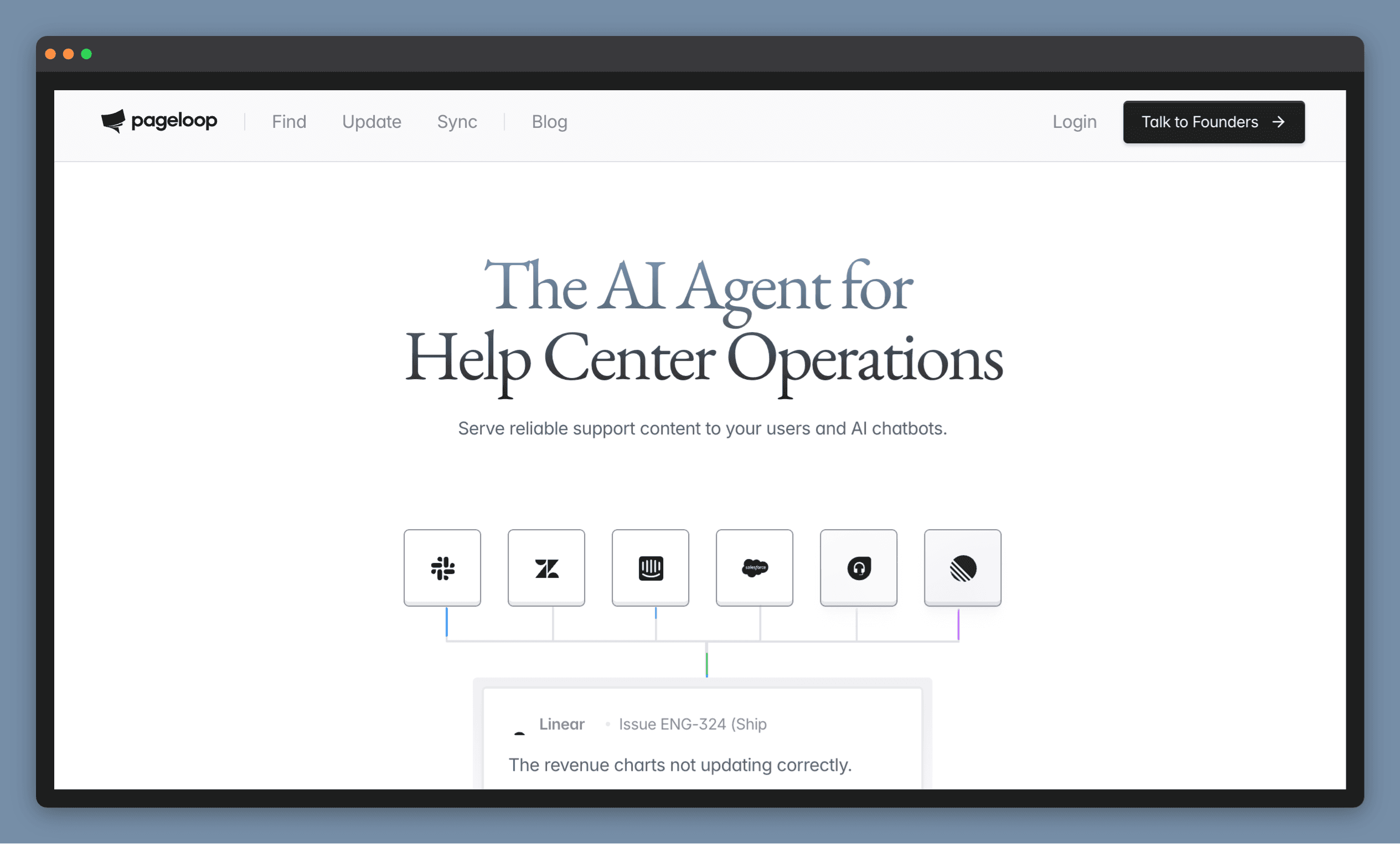
Monitors your product changes and tells you what to fix in your help center. Works on top of Intercom, or hosts your docs directly.
Pageloop does two things most tools on this list do not: it monitors your engineering and support signals, and it generates proactive suggestions when your documentation needs to change. It connects to the sources your team already uses, resolved support tickets, Slack conversations, Linear or Jira tasks, and GitHub activity. When something changes, Pageloop identifies which articles are affected and suggests what needs updating. You review the suggestion, refine it, and publish when you are ready. Nothing goes live without you choosing to publish it.
Pageloop also generates new articles. Record a product flow with the Chrome extension or upload a video, and it produces a complete draft with screenshots embedded in the right places. The same workflow applies to updates: record the new flow, or grant Pageloop permission and it captures the updated screens on its own. Either way, it identifies which existing articles need to change.
If you like Intercom's editor, stay on it: Pageloop connects directly to Intercom, watches your product for changes, and keeps the articles Fin reads in sync, so you improve the parts that frustrate you without leaving the platform you already know. If you would rather move off Intercom entirely, host your docs on Pageloop instead and treat documentation as code, with changes going through review before they publish and every published version carrying an audit trail of who changed what and who approved it. Pricing is based on knowledge base size, not seats, so your whole team can use it either way. Try Pageloop free.
2. Freshdesk
A direct Intercom alternative with its own AI agent and a more structured knowledge base.
Freshdesk is one of the most common platforms teams move to when Intercom's pricing or complexity becomes an issue. It has a native knowledge base, a built-in AI agent called Freddy, and a ticketing system that is more structured than Intercom's conversation-first approach. For knowledge base management, Freshdesk offers article performance analytics and search-term reporting to show what customers look for but do not find, plus workflow automation for article review and approval. Freddy AI can suggest article improvements and flag low-performing content from customer feedback signals.
Where it falls short. Freshdesk has the same fundamental maintenance problem as every other platform here. Nothing proactively knows your product just shipped a change and flags which articles need updating. The analytics tell you what is underperforming after the fact, and the review workflow needs someone to start it. The editor is also not meaningfully better than Intercom's for large content libraries, and moving off Intercom requires real migration work.
Best for. Teams that have outgrown Intercom's pricing model, need more structured ticketing alongside their knowledge base and AI agent, and are prepared to migrate.
3. Help Scout
A clean, straightforward alternative for teams that want simplicity over complexity.
Help Scout is a popular Intercom alternative for support teams that find Intercom over-engineered for their needs. Its knowledge base product, Docs, is well-designed and easy to manage, the interface is clean, and article creation is straightforward. Help Scout's AI features cover the basics without the overhead:
Summarize condenses a long back-and-forth into a couple of lines an agent can scan.
Assist drafts replies and suggests edits.
Article suggestions surface relevant Docs content inside the conversation, so the agent never leaves the inbox.
For teams where AI-powered deflection is not the primary goal, that is often enough.
Where it falls short. Help Scout does not have an AI agent equivalent to Fin. If deflecting customer queries through an AI knowledge base chatbot is central to your strategy, Help Scout is not built for it. Docs is a solid knowledge base, but it is not woven into an AI layer the way Intercom Articles and Fin are, and maintenance tooling is limited: no proactive surfacing of stale content or content gaps from customer queries.
Best for. Teams moving away from Intercom that prioritize a clean agent experience and do not lean heavily on AI-powered deflection.
4. Guru
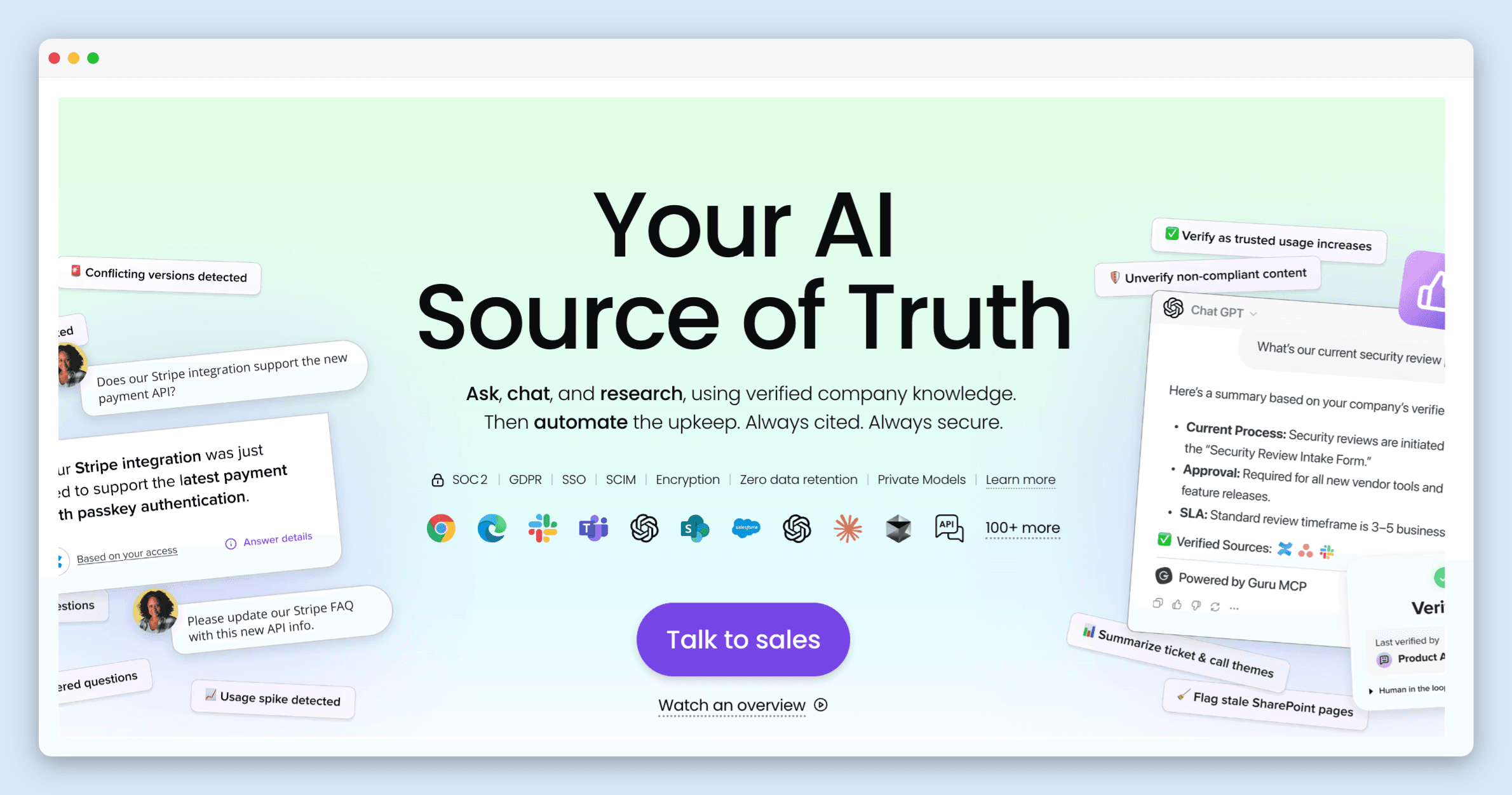
A verified internal knowledge base that syncs with Intercom's AI layer.
Guru is worth including because Intercom natively supports it as an external knowledge source. Internal articles from Guru sync to Intercom's Knowledge Hub every 24 hours, making that content available to Fin and to agents through Copilot. For teams already using Guru for internal knowledge, this removes the need to duplicate content in Intercom Articles. Guru's core strength is automated knowledge quality: its Knowledge Agents continuously evaluate content and un-verify anything that looks outdated, deprioritizing it in search until a human confirms it is still accurate.
Where it falls short. Guru is built for internal knowledge, not customer-facing help centers. The card-based structure and verification workflow suit agent-facing content, but producing a polished, customer-facing help center is not what Guru was designed for.
Best for. Teams already using Guru for internal knowledge who want that content available to Fin and agents in Intercom without building a separate customer-facing help center.
5. Document360
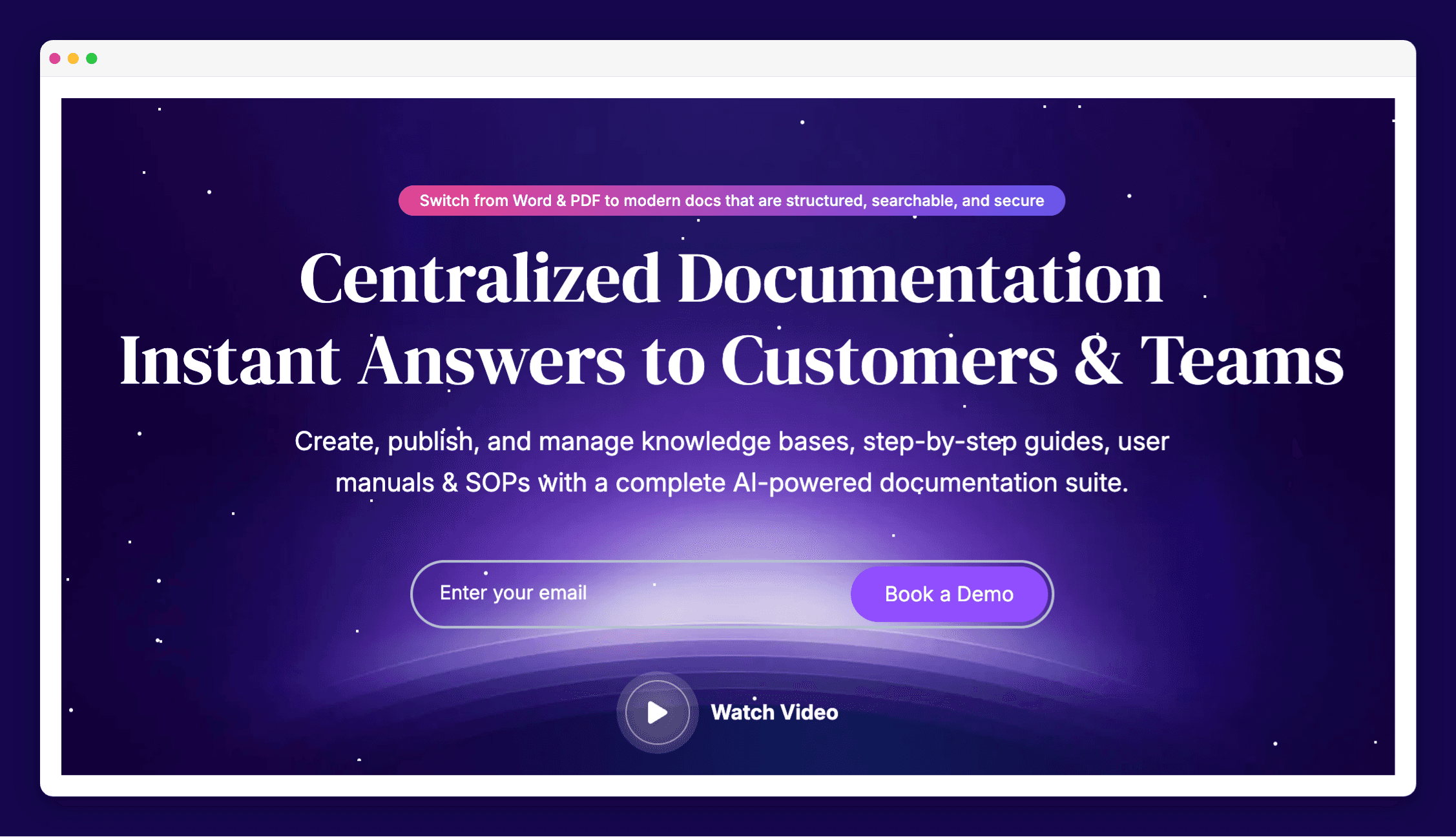
A standalone AI knowledge base with stronger content governance than Intercom Articles.
Document360 is one of the more fully-featured standalone knowledge base platforms, and it integrates with Intercom so agents can search and surface articles inside customer conversations. For teams that need a more structured and customizable help center than Intercom Articles provides, it is a strong option. For maintenance, Document360 offers:
Article review reminders on a cadence your team sets.
Duplicate content detection.
Reporting on searches that return no results, so you can see what customers look for and cannot find.
Data on which articles get referenced most.
Where it falls short. The maintenance features are initiated manually, so review reminders depend on the schedule your team sets. There is no proactive detection of what has gone stale because of a product change; the tool does not know your product shipped something new. Document360 also requires migrating your knowledge base out of Intercom Articles, which is an upfront investment regardless of the long-term payoff.
Best for. Teams that have hit the ceiling with Intercom Articles and need a more structured, customizable AI knowledge base with stronger content governance.
How these tools compare
Tool | Native to Intercom | Finds content gaps | Flags outdated articles | Keeps Fin's knowledge current |
|---|---|---|---|---|
Intercom Articles | Built in | Reactively, via Fin conversations | No proactive flagging | Only if manually maintained |
Freshdesk | Separate platform | Failed searches only | Requires manual review setup | Only if manually maintained |
Help Scout | Separate platform | No | No | No |
Guru | Via Knowledge Hub sync | Usage signals only | Automated un-verification | 24hr sync delay |
Document360 | Via app integration | Failed searches only | Scheduled reminders only | Only if manually maintained |
Pageloop | Direct integration | From tickets, Slack, Jira, GitHub | After every release | Yes, on top of Intercom or hosted directly |
The pattern is consistent: most tools help you build and organize a knowledge base, and very few help you keep it accurate over time. Fin's resolution rate is a reflection of your knowledge base health, so when customers get wrong answers or Fin escalates conversations it should handle, the problem is almost never the AI. It is the articles the AI is reading, and an accurate AI knowledge base does not happen once. It happens after every release.
Frequently asked questions
Is Intercom the same as Fin now?
Yes. Intercom rebranded to Fin in 2026 to reflect its focus on its AI customer service agent, which is also called Fin. The underlying products, including the help center and Knowledge Hub, still exist. The company and its flagship offering now sit under the Fin brand.
What happens to Intercom's knowledge base now that Salesforce is acquiring it?
Salesforce signed a definitive agreement in June 2026 to acquire Fin (formerly Intercom) for about $3.6 billion, with the deal expected to close in Salesforce's fiscal Q4 2027 pending regulatory approval. A few practical takeaways:
Your existing help center and Knowledge Hub keep running through the transition.
Pricing and roadmaps commonly shift after an acquisition of this size.
It is a sensible moment to confirm your knowledge base is portable and to know which tools work on top of Intercom without a migration.
Can I use Notion or Confluence as my Intercom knowledge base?
Partly. Intercom's Knowledge Hub can sync external content sources, including Guru, Confluence, and Notion, so content you already keep there can feed Fin without being rewritten in Intercom Articles. Those tools are built for internal documentation rather than a customer-facing help center, so most teams use them as a source that flows into Intercom, not as the public help center itself.
How do I improve my Intercom Fin resolution rate?
Fin resolves questions by reading your help center articles, so when those articles are outdated or incomplete, Fin either gives wrong answers or escalates to your team unnecessarily. The fastest way to lift resolution rates:
Find the articles Fin reads from that have drifted behind the product.
Fix the gaps Fin escalates on most.
Then keep those articles in sync as the product changes, rather than re-auditing everything once a quarter and hoping it holds.
Pageloop does this by generating proactive suggestions when your product changes, so the articles Fin relies on stay accurate. We wrote a full guide on this: How to Improve Intercom Fin Resolution Rate.
Can I keep using Intercom's knowledge base without switching platforms?
Yes. Several tools work on top of Intercom without requiring you to move your content. Pageloop connects directly to Intercom and adds proactive maintenance: it monitors your engineering and support signals and tells you which articles need attention after each product change. You do not need to migrate, learn a new editor, or change how your agents work.
Why does my Intercom help center keep falling behind product releases?
Most help center tools do not know when your product ships. They give you a place to write and publish, but they do not connect to your release process, so when your team pushes updates through Linear, Jira, GitHub, or Slack, nothing tells your knowledge base to catch up. Pageloop closes that gap by monitoring those sources and generating suggestions when documentation falls out of sync. For more, see How to Use AI to Keep Your Help Center Updated.
Image courtesy National Gallery of Art
Pont Neuf, Paris, Auguste Renoir (French, 1841 - 1919)

Author
Fatema works across marketing and content at Pageloop. She has an academic background in Ecology, a side-life in fashion, and an irrational loyalty to milk coffee.
Other related content you might be interested in


